
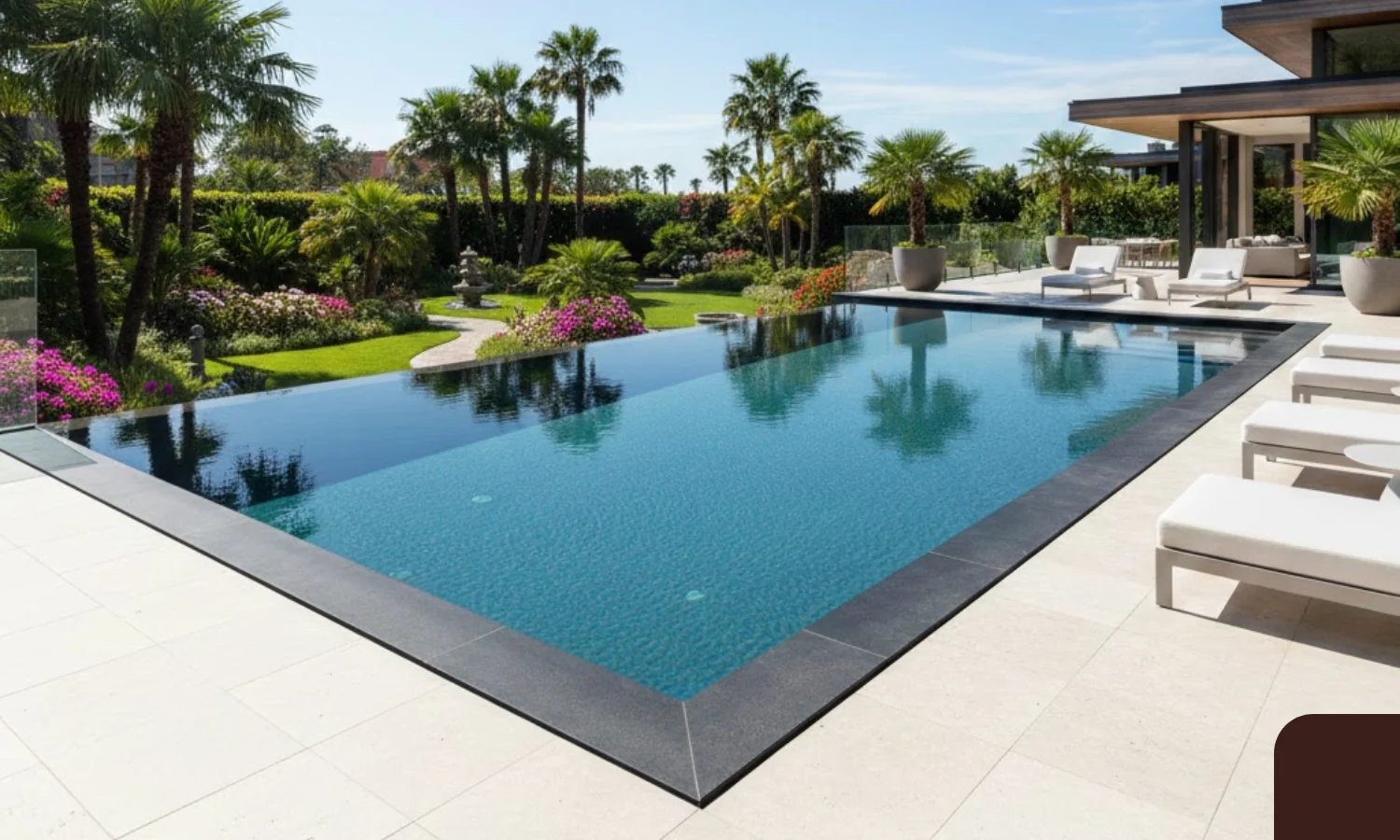
Of all the pool features I’ve built over 45 years, nothing stops a conversation like a vanishing edge done right. Guests walk out to the backyard, see that sheet of water appearing to dissolve into the horizon, and they just stop talking for a second. It’s one of those rare things in residential design that genuinely delivers on what it promises.
But vanishing edge pools – also called infinity pools or negative edge pools, depending on who you ask — are also one of the most misunderstood features in the pool industry. Homeowners see them in resort photos and want that look without fully understanding what goes into achieving it, what it actually costs, and what makes a great one different from a mediocre one.
So let me give you the full picture, from someone who has designed and built quite a few of them right here in DFW.
How Does a Vanishing Edge Pool Work?
The term “vanishing edge” refers to one or more sides of the pool where the water level sits flush with — or slightly above — the pool wall. Water continuously spills over that edge and into a catch basin below, where it’s collected and pumped back into the main pool. From the swimmer’s perspective (and especially from the house looking out), the edge appears to disappear. The water seems to extend to the horizon.
That catch basin is the part most people don’t think about when they’re looking at resort photos. It has to be sized correctly to handle the volume of water that spills over. The recirculation pump has to be powerful enough to return that water continuously. The equipment vault that houses this system needs to be engineered and concealed. All of that infrastructure is what separates a vanishing edge that looks stunning from one that looks like a gimmick.
The engineering requirement is also why vanishing edges work best on sloped lots – you need a meaningful elevation change between the pool deck and the view beyond. A completely flat lot can still accommodate one, but it typically requires building up the pool elevation artificially, which adds cost and changes the design approach entirely.
Tip: If your lot has a slope or drop-off toward the back – especially if you have a view of a greenbelt, golf course, or city lights – you’re sitting on ideal vanishing edge conditions. That topography is the whole reason the feature works as well as it does.
What Does a Vanishing Edge Pool Cost in DFW?
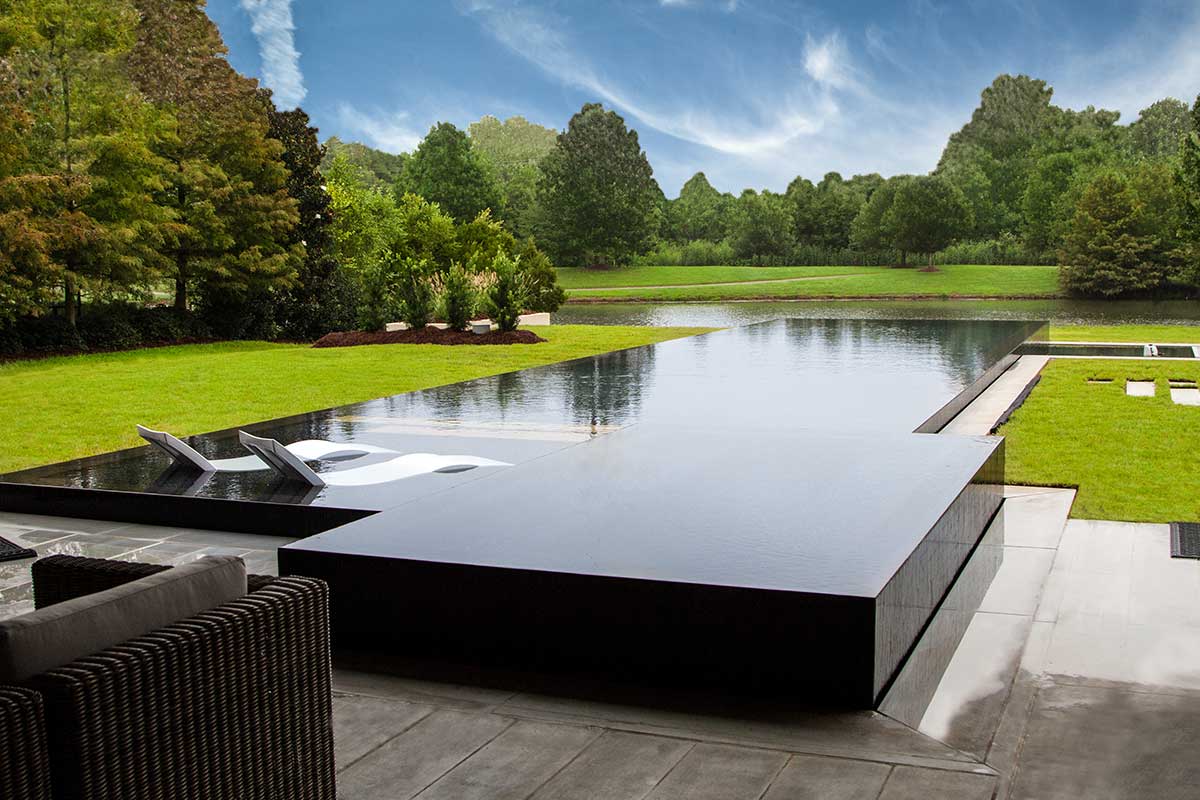
The honest answer is that there’s no such thing as a vanishing edge pool as a standalone product. It’s a feature that gets added to a custom pool design – and both the pool and the edge have to be engineered and priced together.
If you haven’t already looked at our breakdown of what custom pools cost in DFW, that’s the right starting point. A vanishing edge adds to that baseline.
| What You’re Pricing | Added Cost Over Standard Pool |
|---|---|
| Basic vanishing edge (one side) | +$15,000 – $30,000 |
| Two-sided or wrap-around edge | +$30,000 – $55,000 |
| Edge with decorative tile treatment | +$5,000 – $15,000 on top of edge cost |
| Catch basin + hidden equipment vault | +$8,000 – $18,000 |
| Full luxury build with vanishing edge | $175,000 – $300,000+ total project |
What drives the variation: the width of the vanishing edge (a 10-foot edge vs. a 40-foot edge is a very different project), the complexity of the catch basin, how much of the equipment needs to be concealed, and what the tile treatment on the edge itself looks like. The tile and coping on a vanishing edge is often the most visible part of the design — it deserves careful attention.
The tile choices you make for the edge face and the interior of the catch basin are some of the most visible surfaces in the entire design. Our guide on choosing pool tile and coping materials is worth reading before you finalize that part of the design.
Design Considerations Specific to DFW
Building a vanishing edge pool in North Texas has a few specific considerations that are worth understanding before you start designing.
Clay Soil and Structural Engineering
DFW sits on expansive clay soil that moves with moisture changes — expanding when wet, contracting when dry. This is exactly why gunite (shotcrete) is the only construction material I’d recommend for a vanishing edge pool in our area. Fiberglass pools aren’t structurally suited to the engineering demands of a vanishing edge, and the soil movement in our region makes that even more true.
The structural engineering on a vanishing edge pool has to account for soil movement on the edge wall specifically, since that wall is under the most hydraulic stress. This is a non-trivial design challenge, and it’s one reason experience matters. Our comparison of gunite vs. fiberglass goes into more detail on why material choice matters in Texas soil conditions.
The View Has to Justify the Feature
I’ve had clients ask for a vanishing edge on a lot that backs up to a fence six feet away. I talk them out of it — not because it can’t be done, but because the feature only delivers its visual impact when there’s something worth looking at beyond the edge. A greenbelt, a golf course, a rolling terrain, a skyline view, or even a well-designed lower yard can all work. A fence doesn’t.
Browse our completed project portfolio and you’ll see vanishing edges used where they make sense and other luxury features used where they’re more appropriate. That’s a deliberate design philosophy — the feature should serve the space, not the other way around.
Water Chemistry Is More Demanding
A vanishing edge pool has a more complex water circulation system than a standard pool, which means water chemistry requires slightly more attention – particularly keeping the catch basin clean and the recirculation system balanced.
If you’re considering a salt chlorination system (which simplifies ongoing chemistry significantly), our breakdown of saltwater pools in Texas is relevant reading here. Salt systems and vanishing edges work well together.
What the Build Process Looks Like
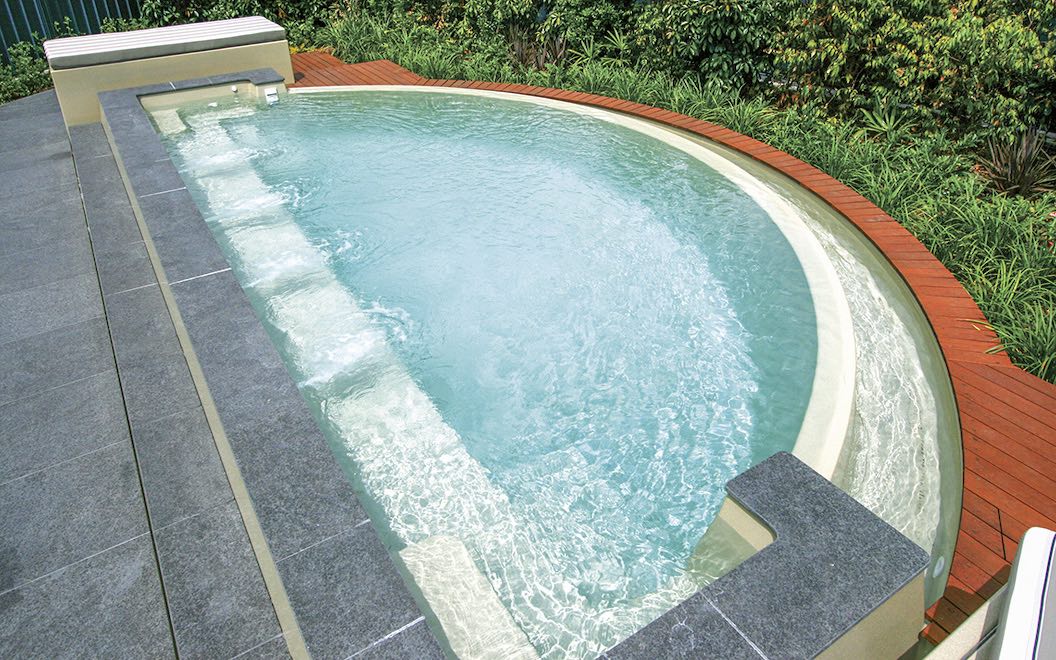
A vanishing edge pool takes longer to build than a standard custom pool — not dramatically longer, but meaningfully so. The additional engineering, the catch basin construction, and the equipment vault installation add roughly 2–4 weeks to a typical build timeline.
Our pool construction timeline guide covers the full process for a standard custom pool in DFW. For a vanishing edge, add those 2–4 weeks primarily in the early structural phase and during the equipment installation phase at the end.
What I tell clients going into a vanishing edge build: the finish work matters more on this project than on almost any other pool type. The edge cap, the tile treatment on the spill face, and the overflow lip all have to be executed with precision.
A sloppy finish on a standard pool is unfortunate. A sloppy finish on a vanishing edge is impossible to miss because the eye is drawn directly to it.
We take our time on that part. It shows in the finished product.
Worth knowing: Timing matters more on vanishing edge builds than on standard pools. The structural work — particularly the edge wall — benefits significantly from fall or winter construction conditions in Texas. If you’re planning one of these, building in the fall or winter gives you the best results on finish quality.
Is a Vanishing Edge Worth It for Your Property?
I get asked this directly sometimes, and I’ll give you the same honest answer I give clients in the design consultation: it depends on your lot.
If you have the topography for it — a meaningful slope, a view worth framing, a backyard that opens up to something — then yes, a vanishing edge is one of the few pool features that delivers exactly what it looks like in photos. It’s not a gimmick. When it’s designed for the right property, it’s genuinely spectacular.
If you have a flat lot with no view, the money is almost always better spent on other luxury features — a high-end spa, a custom water feature, premium lighting, or a full outdoor living space. Those deliver real daily enjoyment without requiring topography you don’t have.
Take a look at our special features and design work and our outdoor living projects to get a sense of what other options are available at a similar investment level. And our award-winning projects show the kind of work we do across the full range of luxury builds.
If you’re trying to understand the full budget picture — pool plus features plus outdoor living — our financing guide for DFW homeowners walks through how people structure these larger investments.
Thinking About a Vanishing Edge for Your Backyard?
The first step is a site visit. I need to see the topography, understand the view lines, and get a feel for what the lot can support before any design work begins. That’s true of any custom pool, but especially true for a vanishing edge where the relationship between the pool and the landscape is everything.
Call us at (972) 335-2777 or reach out online to schedule a consultation. Bring photos of your backyard and any inspiration images you’ve collected — that’s always a good starting point for the conversation.