
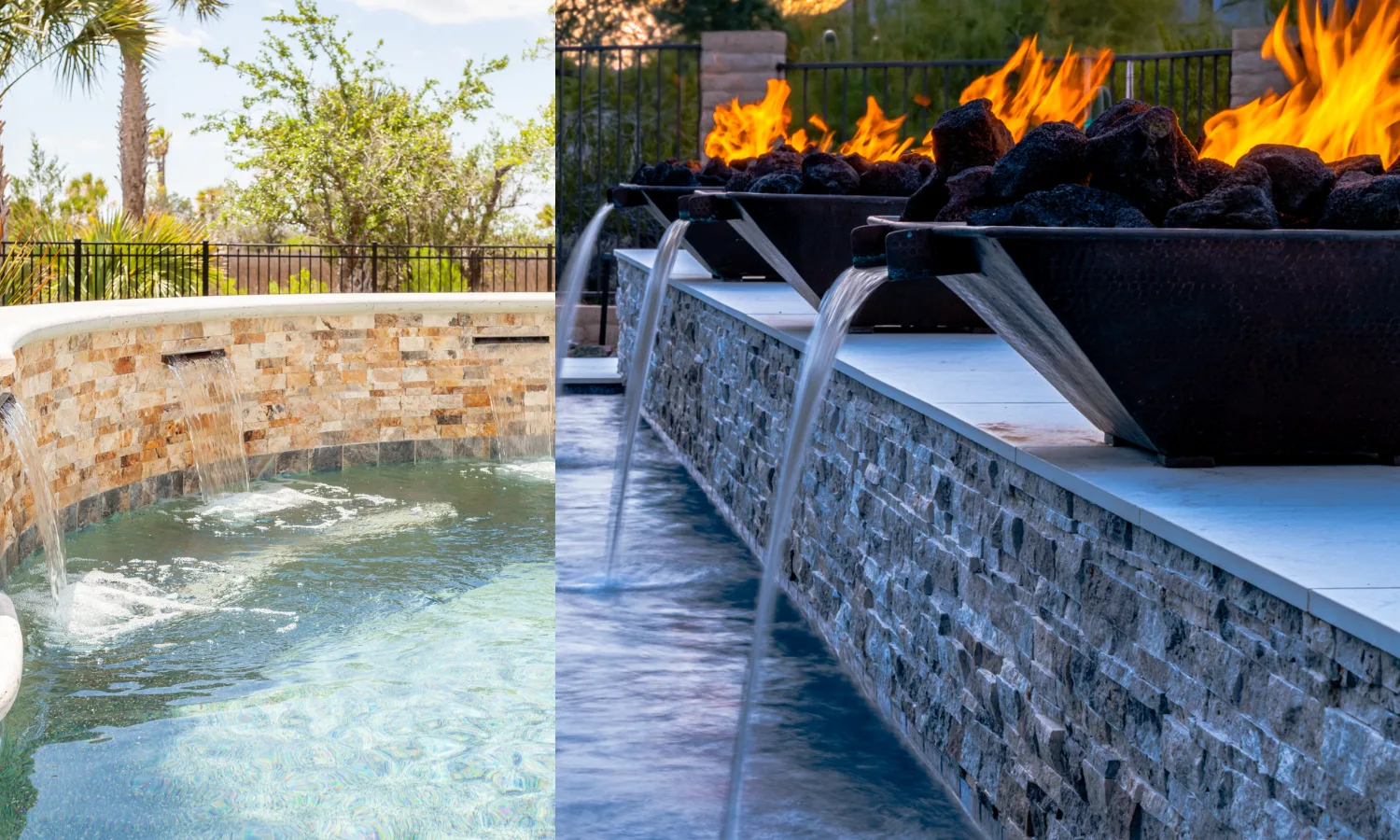
There’s something about moving water that changes the entire feeling of a backyard. A pool sitting still in the heat is one thing. That same pool with a wall of water sheeting over dark tile into the basin below — the sound, the movement, the visual – is something completely different.
Water features are often where a pool goes from nice to genuinely memorable. But they’re also where homeowners sometimes spend money on something that doesn’t match how they use the space. So let me walk through the main options and give you an honest take on each one — including which hold up best in the DFW climate and which require the most ongoing attention.
Deck Jets
Deck jets shoot arching streams of water from the pool deck into the pool itself. Multiple jets arranged symmetrically create a striking visual during the day and, with LED lighting, genuinely dramatic effects at night. They’re adjustable, so you can tune the arc height and spread.
These are a great entry point into water features — moderate cost, meaningful visual impact, and they tie directly into your existing pool pump system, which keeps the equipment footprint small. In DFW, where pools get heavy evening use during summer, lit deck jets punch well above their weight.
- Cost range: $2,000 – $5,000 for a standard setup of 4–6 jets
- Maintenance: Low. Jets are simple mechanical components; occasional nozzle cleaning is all that’s needed
- Best for: Clean modern designs; great companion to a tanning ledge
Sheer Descent / Waterfall
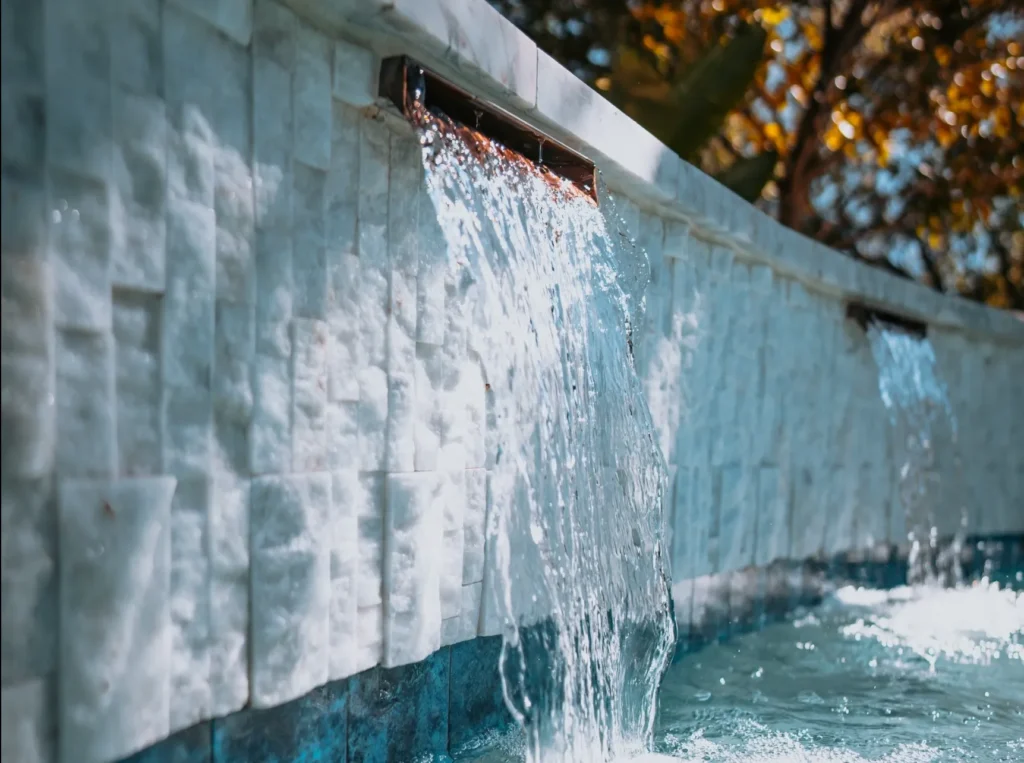
A sheer descent sends a flat, unbroken sheet of water from an elevated spillway into the pool. When installed correctly with the right flow rate, the water drops in a clean glassy curtain — no turbulence, no spray — that looks like something from a high-end hotel. It’s one of the most visually sophisticated water features at a residential scale.
The key word is “correctly.” A sheer descent that’s underpowered produces a broken, dribbling curtain that looks like a leaking gutter. A sheer descent properly spec’d and installed produces something that stops guests mid-conversation. Execution matters here more than almost anywhere else in pool design.
- Cost range: $3,000 – $8,000 per descent, depending on width and height
- Maintenance: Low. Keep the weir (the spillway lip) clean; occasional flow adjustment as pump equipment ages
- Best for: Contemporary and transitional designs; pairs beautifully with dark tile finishes
Tip: The tile or stone face behind a sheer descent becomes one of the most prominent visual elements in your pool design. Give it the same attention as the pool interior finish — it earns it.
Spillway Bowls and Raised Spa Spillovers
A raised spa that overflows into the main pool is one of the most classic luxury pool features — water cascades continuously from the elevated spa into the pool, creating constant movement and sound. Paired with good lighting, it’s hard to beat for nighttime visual impact.
Spillway bowls serve a similar function with more design flexibility. Large decorative bowls — typically cast stone, fiberglass, or concrete — positioned at the pool’s edge send a curtain of water into the pool below. They work well on raised water walls and as standalone architectural elements.
- Raised spa spillover: Incremental cost above spa addition; typically $1,500 – $4,000 for the spillway element itself
- Spillway bowls: $2,500 – $6,000 per bowl depending on size and material
- Maintenance: Low for both; keep the bowl and spillway surfaces clear of algae and calcium buildup
Grottos and Cave Features
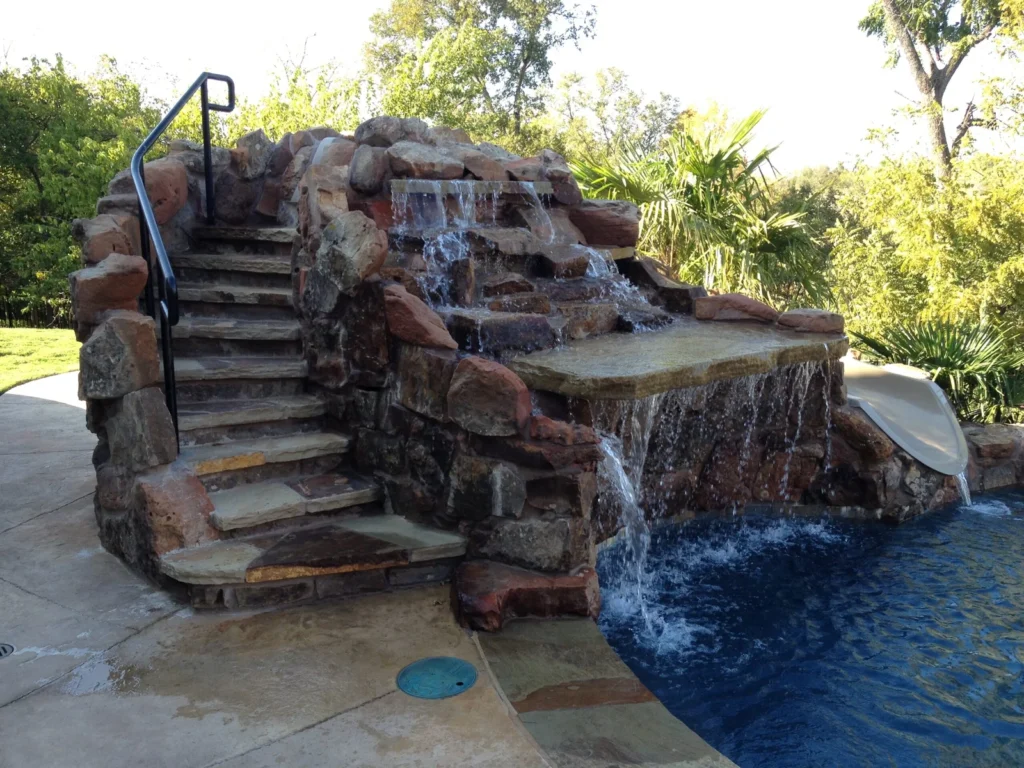
A grotto — a rock-formed cave or enclosure built over the pool — is the kind of feature that kids absolutely love and adults appreciate more than they expect to. You swim through an opening into a shaded space with water all around, and the heat simply disappears. In Texas in July, that’s not a gimmick. That’s genuinely useful.
Grottos require more structural engineering than simpler water features and need meaningful pool volume to work within. They’re best suited to larger builds on bigger lots. But done right, they tend to become the defining feature of a backyard — the thing guests talk about for years.
- Cost range: $15,000 – $40,000+ depending on size and complexity
- Maintenance: Higher than simpler features — rock surfaces collect algae and need regular brushing; lighting inside grottos needs periodic replacement
- Best for: Larger lots with naturalistic or freeform pool designs; families with kids
Fire-and-Water Features

This is where things get genuinely dramatic. A fire-and-water wall — where flames emerge from the same structure that sends water into the pool — creates an outdoor space that feels designed at a resort level. We go deeper on fire features in our post on fire pit and pool combinations in North Texas, but the standalone fire-and-water format deserves mention here.
In DFW’s climate, fire features get meaningful use from October through April — which is a genuinely long outdoor season. The visual contrast of fire and water, especially at night, creates an atmosphere that’s very difficult to replicate with any other element.
- Fire-and-water bowls: $3,000 – $8,000 per bowl
- Fire-and-water wall: $8,000 – $20,000+
- Maintenance: Gas components need annual inspection; burner ports need clearing periodically
Automation: Controlling Everything From Your Phone
This is a section most water feature guides skip over, and it shouldn’t be skipped. Every water feature you add is something you have to turn on and off — and if doing so requires going to an equipment panel and manually operating valves, people simply use features less. They become decoration instead of daily enjoyment.
Modern pool automation systems from brands like Pentair IntelliCenter and Hayward OmniLogic let you control every feature — jets, sheers, bubblers, lighting, fire features — from your phone or a wall panel. You can set schedules (deck jets run from 7–10pm daily), create scenes (“entertaining mode” activates the spillway, sheers, and color lighting simultaneously), and adjust everything without leaving your chair.
Adding automation to a new build costs $3,000–$7,000 depending on how many features need to be controlled. It’s one of the most consistently undervalued upgrades in pool design, because the usability difference is enormous. Features you can control effortlessly get used constantly. Features that require manual operation get used occasionally.
- Automation system cost: $3,000 – $7,000 installed for a full-feature setup
- What it controls: Pump speed, lighting, water features, heater/chiller, salt system, fire features
- Best brands: Pentair IntelliCenter, Hayward OmniLogic — both have strong app interfaces and dealer support in DFW
Which Features Are Lowest Maintenance?
Since maintenance is a real consideration — especially for homeowners who don’t want a pool that feels like a second job — here’s an honest ranking from lowest to highest maintenance burden:
| Feature | Maintenance Level | Main Upkeep Task |
|---|---|---|
| Deck jets | Very Low | Occasional nozzle cleaning |
| Sheer descent | Low | Keep weir lip clean; flow check annually |
| Spillway bowl | Low | Surface algae; calcium buildup on bowl |
| Spa spillover | Low | Same as spa maintenance generally |
| Fire-and-water features | Moderate | Annual gas inspection; burner port clearing |
| Grotto / cave | Higher | Regular brushing; interior lighting upkeep |
How Do You Choose the Right Water Features for Your Pool?
The worst thing you can do with water features is treat them as a checklist. More features don’t make a better pool — they make a busier pool. The best designs pick one or two features that work with the architecture of the pool and execute them really well.
A clean contemporary pool might get a single well-placed sheer descent and lit deck jets. A naturalistic freeform pool might get a grotto and a rock waterfall. A vanishing edge pool often needs nothing else — the edge is the feature. The discipline of restraint in water feature selection is something you develop after seeing hundreds of finished pools.
If you’re in the early stages of figuring out what your overall budget can support, our 2026 pool pricing breakdown gives you the full picture before you start stacking features on top of it. And our vanishing edge pool guide explains why certain features work better when the pool itself is already a statement.
Browse our completed project portfolio and special features gallery — both show these elements in real DFW builds.
Let’s Design Something Worth Coming Home To
Call us at (972) 335-2777 or schedule a consultation online. Water features are one of the more personal decisions in pool design — bring your inspiration images and let’s talk through what fits your space and how you actually use your backyard.