
Fire and water shouldn’t work together. And yet they do – almost universally. I’ve built hundreds of pools over the decades and added fire features to more and more of them over the last fifteen years. Without exception, they become the element guests notice and remember.
There’s also a practical reason fire features are particularly well-suited to North Texas: our winters are mild enough that a backyard with a fire feature genuinely gets used in October, November, December, and March in ways that northern markets simply don’t experience. You’re extending the outdoor season, not just decorating for summer.
What Is the Best Fire Feature to Add Near a Pool?
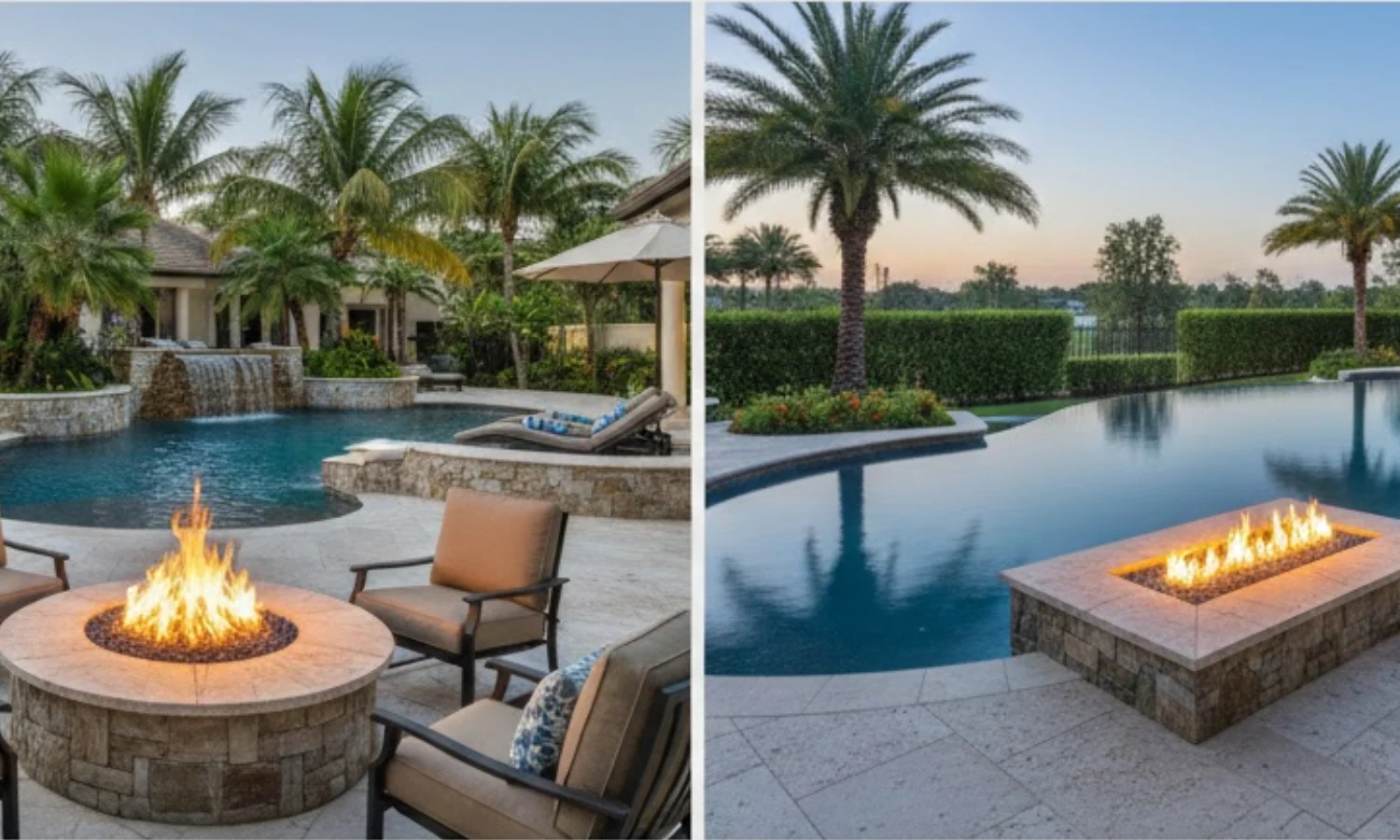
A built-in fire pit positioned near the pool – but not at pool edge — creates a separate outdoor living zone that functions year-round. Summer nights, people are in the pool. October nights, they’re gathered around the fire. The two zones complement each other and create a backyard that actually gets used across seasons.
Built-in fire pits can be round, square, rectangular — whatever suits the overall design language. Gas-fired options are the practical choice for most homeowners: turn on, turn off, no wood, no ash, no smoke. A gas fire pit with a dedicated gas line is cleaner, more controllable, and frankly more used because it’s effortless.
How Far Should a Fire Pit Be From a Pool?
Keep a minimum of 8–10 feet between a fire pit and the pool edge. This is partly safety — fire, sparks, and pool chemicals don’t mix well – and partly functional. You want the fire area to feel like a distinct zone, not something crammed against the pool.
The sight line between fire pit and pool should be intentional. Some of the best designs I’ve done position the fire pit so that from the pool, you look across the water and see the fire reflected in it. That effect — fire reflected in a dark pool at night — is genuinely spectacular.
- Cost range: $4,000 – $12,000 for a built-in gas fire pit, including gas line run
- Best materials: Concrete, natural stone, or stucco-finish block — materials that match your pool coping and outdoor kitchen for a cohesive look
What Are Fire Bowls and How Do They Work With a Pool?
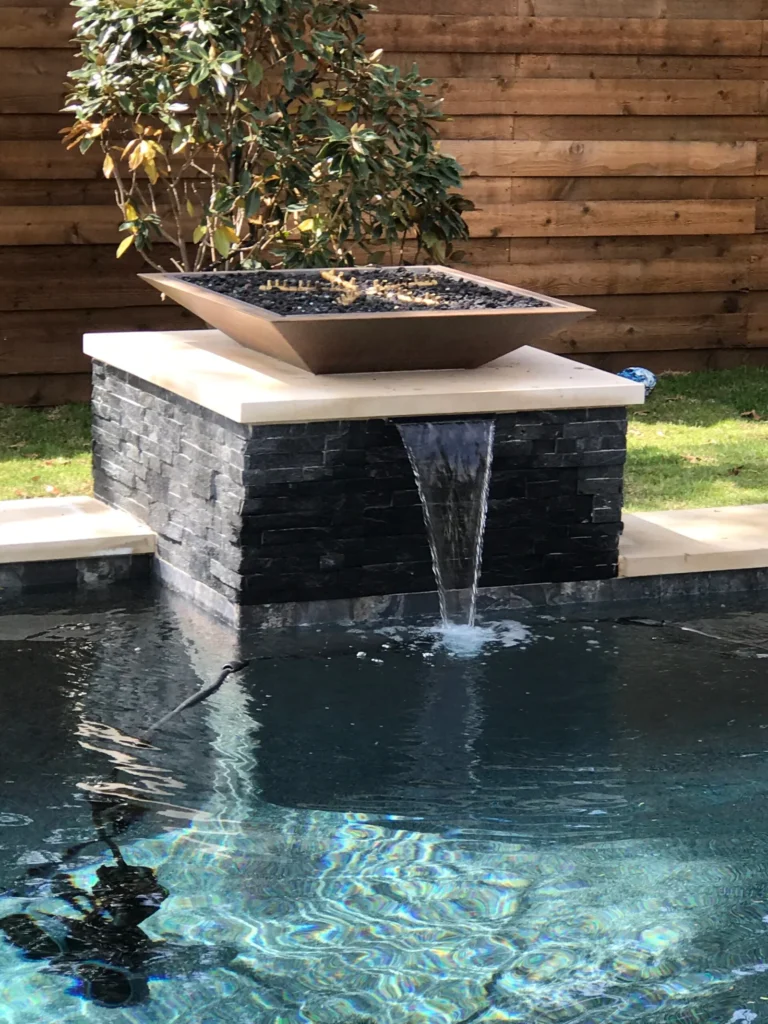
Fire bowls sit elevated on pedestals – typically 24–36 inches off the ground – and bring flame to eye level rather than ground level. They’re popular because they can be positioned at the pool edge in a way that a fire pit can’t, and the height creates a more dramatic visual statement.
A pair of fire bowls flanking a pool entrance or positioned at the corners of a vanishing edge are some of the most striking residential pool designs I’ve built. The elevation means the flames are visible from inside the pool, which is the whole point.
Fire bowls are also one of the better crossover features between pools and outdoor kitchens – a fire bowl near the outdoor kitchen adds atmosphere to the dining area. Our post on pool and outdoor kitchen design in DFW covers how these pieces work together in the overall design.
- Cost range: $2,500 – $7,000 per bowl including gas connection
- Typical size: 18″ – 30″ bowl diameter; larger bowls make more visual impact
Fire-and-Water Walls: The Statement Feature
A fire-and-water wall is exactly what it sounds like: a vertical structure where water sheets down one face while gas flames run along the top or through channels in the structure. Fire above, water below. They’re the most dramatic fire feature available at a residential scale, and when they’re done well they’re genuinely stunning.
The design requirements are specific: the structure needs to be engineered so that water flow and flame don’t interfere with each other. The materials need to handle both heat and constant water exposure. The gas supply needs to be properly sized. These aren’t projects for contractors guessing their way through it — the construction details matter.
Fire-and-water walls work especially well integrated into the pool’s retaining wall or as a freestanding feature at the back of the pool. They’re also effective as a focal point in an outdoor kitchen/dining area. The key is that they need to be visible from where people are sitting and swimming — otherwise you’ve built a feature nobody looks at.
- Cost range: $8,000 – $25,000+ depending on size and complexity
- Best placement: At the back or side of the pool, visible from the primary lounging and seating areas
Fire-and-Water in the Pool Itself
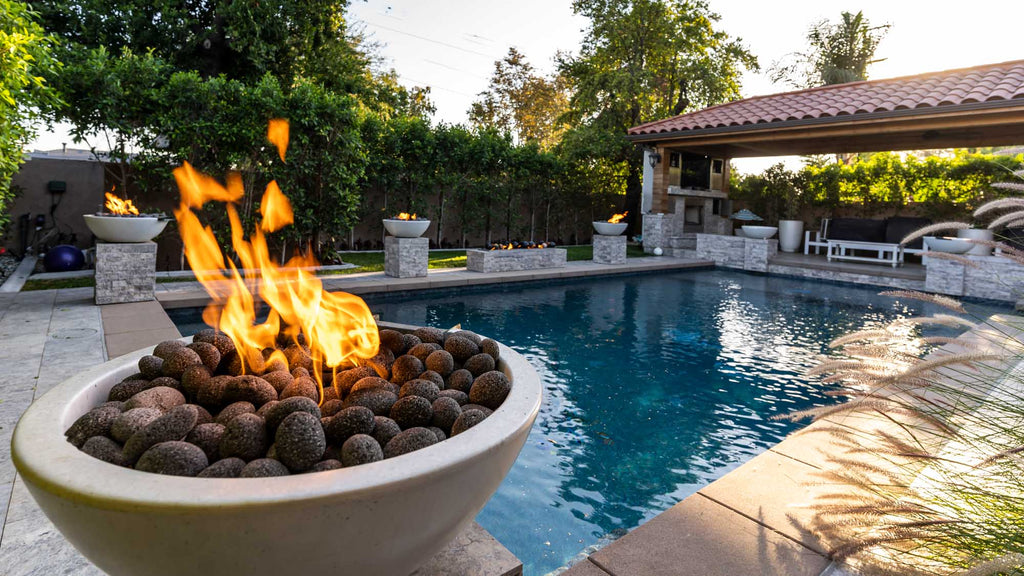
Some of the most memorable DFW pools I’ve built incorporate fire elements directly within or immediately adjacent to the water. Brass fire pots rising from a shallow ledge. Stainless torch fixtures mounted at pool edge. A fire table positioned at the pool’s conversation area.
When flames are surrounded by water at night — especially a dark-finish pool that reflects well — the effect is hard to describe without seeing it. It becomes the dominant visual experience of the backyard. People stop talking when it’s lit for the first time.
Should You Choose Gas or Wood-Burning for a Pool Fire Feature?
I have nothing against a wood fire in the right context. But next to a pool, in a residential backyard, wood fires introduce ash and embers that end up in the pool water, smoke that drives people inside, and the management burden of wood, kindling, and cleanup.
Every fire feature we install is gas. Natural gas if you have it; propane with a tank if you don’t. The usability difference is enormous — push a button, have fire. That’s the version that actually gets used every week rather than on the rare occasion someone feels like dealing with it.
What Does the North Texas Climate Mean for Fire Features?
More than you might think. DFW averages a genuinely comfortable outdoor evening temperature from late September through mid-April — that’s roughly seven months where a fire feature gets meaningful use. Compare that to coastal California (mild year-round, fire less necessary) or the northeast (too cold for pool and fire to coexist most of the year).
In North Texas, the combination of a pool for summer and a fire feature for shoulder seasons means your outdoor space has a reason to be used from March through November. That’s the investment case for fire in this specific market.
And if you’re timing when to build — pool and fire features together or in sequence — our post on the best time of year to build a pool in Texas is relevant since fire feature installation follows pool construction scheduling in the same way.
How Much Do Pool Fire Features Cost in DFW?
Fire features are most cost-effective when they’re planned alongside the pool from the start — the gas line runs happen once, the design is cohesive, and there’s no need to demo existing decking to run infrastructure. If you’re still working out your overall project budget, our 2026 DFW pool cost breakdown is the right starting point.
| Feature | Typical Cost (DFW) |
|---|---|
| Built-in gas fire pit | $4,000 – $12,000 |
| Fire bowls (per bowl) | $2,500 – $7,000 |
| Fire-and-water wall | $8,000 – $25,000+ |
| Fire table | $2,000 – $5,000 |
| Gas line run (if needed) | $800 – $2,500 |
Ready to Add Fire?
Take a look at our special features gallery and outdoor living projects to see fire features in context with real DFW pools and outdoor spaces.
Call us at (972) 335-2777 or schedule a consultation online. Fire features are one of the more personal design decisions – bring your inspiration images and let’s talk through what works with your specific backyard.